





16 Minutes reading time
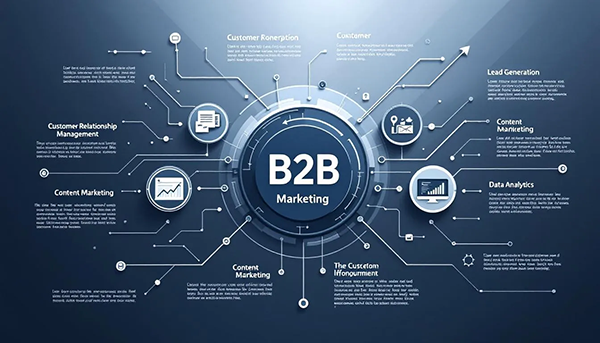
B2B marketing helps companies to identify other companies as Attract customersBut what makes this marketing strategy so effective? In this article, we highlight the most important aspects and trends you should know by 2025.
Key facts at a glance
- B2B marketing focuses on selling products and services to businesses, with long-term business relationships and trust being key elements.
- Important Strategies in B2B marketing include Inbound Marketing, Account-Based Marketing (ABM) and lead generation, which emphasize targeted content and personalized communication for business customers.
- Future trends in B2B marketing include the use of Artificial intelligence, automation and Video marketing to increase efficiency and improve the Customer retention.
What is B2B marketing?
B2B marketing, short for Business to Business Marketing, refers to the sale of products or services to others B2B companies, instead of end consumers. This form of marketing encompasses specific strategies and tactics aimed at meeting the needs of business customers and building long-term business relationships. The main difference between B2B and B2C marketing The key difference lies in the fact that the former targets businesses, while the latter addresses end customers in the B2C sector. Within B2B online marketing, targeted approaches are developed to increase the effectiveness of marketing measures. The definition of marketing is crucial for understanding the various approaches in the B2B business.
A key objective of B2B marketing is to increase brand awareness, establish strong business relationships, and boost sales. Effective B2B marketing measures can create a competitive advantage and secure long-term customer loyalty. This is achieved by developing tailored solutions that meet the specific needs and challenges of business customers.
A well-thought-out B2B marketing strategy can not only increase sales but also solidify a company's reputation as a trusted partner. Companies that are able to continuously offer their business customers added value can benefit from stable and profitable business relationships in the long term.
Differences between B2B and B2C marketing
The differences between B2B and B2C marketing are profound and influence how marketing strategies are developed and implemented:
- In the B2B sector, personal relationships and long-term business connections are crucial.
- In B2C marketing, a more emotional and relaxed approach often dominates.
- Business customers place great value on trust and reliability.
- Purchasing decisions in the B2B sector are generally more complex and long-term.
The purchasing process in B2B marketing is often structured and involves multiple approval stages, making it significantly longer and more complex than in the B2C sector. Decisions are frequently made collaboratively, often involving multiple decision-makers, which further slows down the process. In contrast, purchasing decisions in B2C marketing are usually more spontaneous and less planned, which influences the outcome.
Another difference between B2B and B2C lies in market size: While the B2C market consists of millions of end consumers, the B2B market is comparatively smaller and comprises a limited number of businesses. This means that B2B marketers need to tailor their marketing efforts more precisely and personally to meet the specific needs of their business customers.
Finally, the approach and communication channels also differ in B2B marketing. Here, the focus is on creating business value and providing comprehensive information to gain the approval of decision-makers. Communication is often more direct and solution-oriented, whereas B2C marketing frequently uses emotional and entertaining approaches.
Key B2B marketing strategies
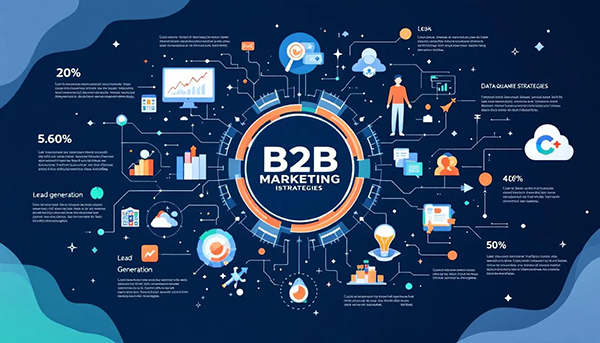
To succeed in B2B marketing, companies must employ a variety of strategies tailored to the specific needs and challenges of their business customers. One of the most important pillars of B2B marketing is the use of relevant and engaging content that builds trust and competence. Two prominent companies, Atlassian and Adobe, serve as examples of innovative and effective B2B marketing strategies.
Developing an effective B2B marketing strategy begins with defining concrete and measurable goals. Long-term relationships and trust are crucial for success in the B2B sector.
In the following sections, we will examine three essential strategies in detail: Inbound Marketing, Account-Based Marketing (ABM), and Lead Generation.
Inbound Marketing
Inbound marketing attracts potential customers by creating valuable content that addresses their specific needs and challenges. Instead of using intrusive advertising, inbound marketing focuses on attracting and retaining potential customers through helpful and informative content. This strategy is particularly effective in B2B marketing, as business customers often seek detailed information and solutions to help them overcome their business challenges.
A successful inbound marketing program includes various types of content, such as:
- blog posts
- Whitepapers
- Case Studies
- Webinars
This content is intended not only to inform, but also to gain the trust of the target group and guide them through the fundamentals of the marketing funnel.
By continuously providing valuable content, companies can strengthen their authority and credibility in their industry and build long-term customer relationships.
Account-Based Marketing (ABM)
Account-based marketing (ABM) is a targeted strategy that focuses on addressing and nurturing individual customer accounts. Unlike lead-based marketing, which targets a broad audience, ABM is characterized by the following features:
- Each customer is considered a separate market.
- Tailor-made solutions are offered, adapted to the specific needs and challenges of the customer.
- Personalized communication increases the efficiency of marketing activities.
- This leads to a higher conversion rate.
A key advantage of ABM is the ability to focus resources on lucrative customers, thereby maximizing marketing efficiency. Contextual personalization allows companies to provide more relevant and engaging content that is better tailored to the needs of their target accounts. This leads not only to higher conversion rates but also to stronger and longer-lasting customer relationships.
Successful implementation of ABM requires close collaboration between marketing and sales. This collaboration is crucial for the strategy's success. Key aspects include:
- Marketing teams must provide comprehensive information and compelling arguments to gain the approval of decision-makers.
- Good storytelling plays an important role in developing compelling narratives.
- The narratives are intended to build trust and reduce complexity.
lead generation
Lead generation is a key component of B2B marketing, aiming to convert prospects into paying customers through targeted marketing campaigns. B2B marketers benefit from this. lead generationby filling their sales pipeline and increasing brand awareness. Effective lead generation tactics include:
- Landing Pages
- Marketing automation
- Email campaigns
- targeted follow-up activities
In the B2B sector, a highly effective strategy is to combine digital marketing with personal contact. This combination allows companies to leverage the advantages of both approaches. Companies can build trust and loyalty with B2B customers by communicating consistently and offering tailored solutions.
Close cooperation between sales and marketing is also important in order to integrate the goals and lead generation and thus ensure the success of the marketing strategy.
Effective B2B marketing measures
Effective B2B marketing measures are crucial for achieving desired results and successfully reaching target groups. Around one-third of B2B marketing efforts in Germany are focused on offline activities, including trade fairs and conferences. These events offer an excellent opportunity for direct contact with potential customers and building trust in the field of online marketing.
The selection of marketing channels should be based on target group and competitor analyses. A thorough competitive analysis is essential for differentiating oneself from other companies and developing targeted marketing strategies. In addition to offline measures, online marketing channels such as [examples of online marketing channels would be inserted here] also play a role. Content Marketing, social media and E-mail marketing Marketing plays a crucial role in B2B marketing. The implementation of marketing measures is essential for success.
Innovative measures such as Storytelling Personalized experiences at events can also capture the interest of the target audience. By combining different marketing channels and strategies, B2B companies can increase their reach and build stronger relationships with their business customers while optimizing the customer journey.
B2B content marketing
Content marketing is one of the most effective B2B marketing strategies for building trust and authority. High-quality, informative content can strengthen the confidence of business customers and positively influence their purchasing decisions. Companies that position themselves as authorities and consistently provide valuable content attract qualified leads and foster long-term customer relationships.
B2B content marketing involves creating and distributing educational content for the target audience. This includes formats such as:
- Case Studies
- White paper
- blog posts
- Videos
- Info graphics
This content is intended not only to inform, but also to gain the trust of the target group and guide them through the marketing funnel.
Atlassian is a prime example of successful B2B content marketing. The company uses community-oriented content marketing to increase trust and visibility within its target audience. Atlassian's content hub offers users a variety of formats, including:
- blog Article
- Whitepapers
- Tutorials: By creating a platform for valuable information and best practices, Atlassian fosters a competent and engaged community.
B2B email marketing
Email marketing offers direct contact with potential and existing customers, which is crucial for B2B companies. It's not just about sending blatant sales emails, but rather about providing recipients with genuine added value. Personalized emails tailored to the specific needs of the recipients significantly increase the effectiveness of B2B marketing campaigns.
Examples of successful B2B email marketing include welcome emails, webinar invitations, and sharing new blog posts. Email marketing software is a standard component of any B2B marketing strategy, enabling companies to efficiently manage and optimize their email campaigns.
B2B social media marketing
Social media is playing an increasingly important role in B2B marketing. These platforms allow companies to expand their reach and directly address potential customers. LinkedIn is the most important platform in B2B marketing, followed by YouTube. YouTube offers tutorials, product demos, and longer videos to explain complex products and services.
The goal of B2B social media marketing is to reach more potential customers and Followers to reach their target audience and build authority. By regularly sharing relevant and informative social media posts, companies can continuously engage their target group and increase brand awareness. Social media also offers the opportunity to enter into direct dialogue with potential customers and gather their feedback.
Successful B2BSocial media strategies This includes the regular publication of high-quality content and active interaction with the target audience. Through the targeted use of social media, companies can not only increase their reach but also strengthen the trust and loyalty of their customers.
Tools and technologies in B2B marketing
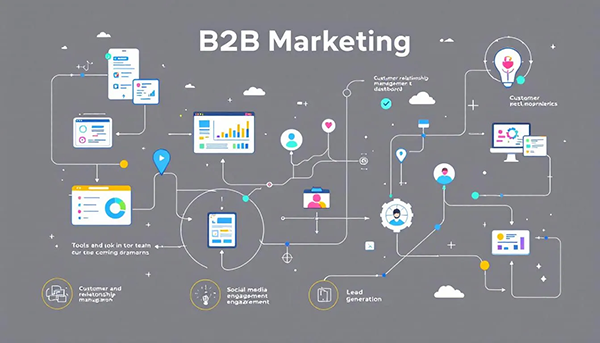
The right tools and technologies are crucial for success in B2B marketing. Platforms like HubSpot offer comprehensive features for CRM, email marketing, and more.Marketing and analyticsThis makes it a central solution for B2B marketing. Salesforce Pardot is another important tool for automating B2B marketing, enabling targeted campaigns and comprehensive analytics.
CRM systems, marketing automation platforms and SalesEnablement tools are crucial. They foster collaboration between marketing and sales. Tools like SEMrush offer valuable insights into SEO and competitive analyses, which are crucial for optimizing online presence in B2B marketing.
Furthermore, technologies like BuzzSumo help B2B marketers identify trending topics and optimize content strategies that form the core of their marketing efforts.
Trends in B2B Marketing 2025
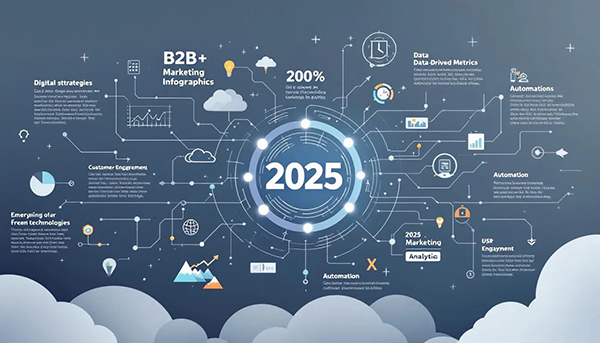
In 2025, several important trends are emerging in B2B marketing that will shape the industry:
- Storytelling is seen as a forward-looking strategy to create differentiation and reduce complexity.
- A clear positioning and differentiation from competitors is becoming increasingly important in order to stand out in the B2B market.
- Hyperpersonalization is also gaining importance as it increases relevance for customers.
These trends demonstrate continuous development and the emergence of new approaches in B2B marketing. Companies must constantly adapt and refine their marketing strategies to remain competitive and meet the evolving needs of their business customers. The trend shows that…
Artificial Intelligence
The use of artificial intelligence (AI) in B2B marketing promotes:
- the quality and efficiency in the creation of marketing content.
- Personalization of communication through automated and individualized addressing.
- The ability to recognize patterns in large datasets, which improves targeting and personalization in marketing.
By integrating AI into marketing strategies, companies can increase their efficiency and respond more effectively to customer needs. AI-based tools and applications make it possible to design more precise and effective marketing campaigns, ultimately leading to better results and higher customer satisfaction.
Automation
Marketing automation is becoming increasingly popular in the DACH region as AI opens up new possibilities. These automation technologies enable companies to make their marketing efforts more efficient and to scale them.
By automating routine tasks, marketing teams can focus their resources on more strategic tasks, thereby maximizing the success of their campaigns.
Video and live streaming
Video marketing reaches new target groups and appeals to potential customers in a visually engaging way. The advantages and methods of video marketing are:
- The brand is humanized and trust is built with the audience.
- Live streams, such as webinars, strengthen customer relationships.
- Livestreams convey expert knowledge and enable direct interaction.
Innovative approaches such as virtually accessible exhibition spaces and live-streamed training sessions offer exceptional opportunities in B2B marketing. Companies like Semrush use videos to present creative marketing ideas and reach a broader target audience.
Successful examples from B2B marketing
Successful examples from B2B marketing can serve as inspiration and demonstrate how innovative strategies can be implemented. Two outstanding companies in this field are Atlassian and Adobe, which have achieved impressive results through their creative and effective marketing measures, building upon successful examples.
Example 1: Atlassian
Atlassian is a prime example of successful B2B content marketing. The main goal of Atlassian's content marketing is to create a platform for valuable information and best practices. Atlassian's core products, Jira and Confluence, support companies in project and knowledge management. Jira helps teams plan, track, and manage projects, while Confluence serves as a collaborative knowledge base.
By providing high-quality content and fostering an engaged community, Atlassian has built a strong brand in the B2B sector. Content marketing strategy aims to build trust and foster long-term customer relationships.
Example 2: Adobe
Adobe has achieved impressive success in B2B marketing through its innovative use of social media, particularly TikTok. Adobe's engagement on TikTok has resulted in over seven million likes and a large following. Adobe has over half a million followers on TikTok and achieves high view counts with its creative videos.
Adobe's second TikTok video garnered over two million views, demonstrating the effectiveness of social media in B2B marketing. By creatively utilizing platforms like TikTok, Adobe reaches a broad target audience and strengthens its brand presence in both the B2B and B2C sectors.
Best practices in B2B marketing
In B2B marketing, companies pursue the following goals:
- Generating qualified B2B leads
- Building customer relationships
- Sales increase
- Increasing brand awareness to achieve their goals.
The core of successful B2B marketing strategies is content marketing, which demonstrates expertise and builds trust.
Popular best practices in B2B marketing include clear goal definition, target group analysis, targeted communication, and effective lead nurturing. Long-term business relationships are important for customer retention, and close collaboration between sales and marketing promotes campaign success.
B2B Marketing Strategies – Overview, Benefits & Practical Tips
| B2B strategy | Objective | Typical channels | Suitable for | Practical tip |
|---|---|---|---|---|
| Content Marketing | Trust & Expertise | Blog, white papers, case studies | SMEs & Enterprises | In-depth content instead of advertising copy. |
| Account-Based Marketing (ABM) | Acquiring key customers | LinkedIn, email, sales | B2B with big deals | Closely integrate marketing and sales |
| SEO & B2B Keywords | Increase visibility | Google, website | Long-term growth | Prioritize decision keywords |
| LinkedIn marketing | Reaching decision-makers | LinkedIn Posts & Ads | B2B & Services | Using personal profiles |
| Email Marketing | Developing leads | Newsletters, automations | Lead-based models | Segmentation is mandatory |
| Lead Magnets | Collect contact details | Landingpages | Lead generation | Offer high-quality content |
| Webinars | Demonstrate expertise | Live events, on-demand | Consulting & SaaS | Incorporate interactive Q&A |
| Case Studies | build up trust | Website, Sales | Complex products | Figures & results show |
| performance marketing | Scaling leads | Google Ads, LinkedIn Ads | Fast results | Closely track campaigns |
| Marketing Automation | Increase efficiency | CRM, Email Tools | Growing companies | Only relevant triggers |
| B2B Influencer | Reach & Credibility | Expert influencers | Niche markets | micro-influencers use |
| Events & trade fairs | Personal contact | Offline & Hybrid | Industry & Mechanical Engineering | Planning preparation and follow-up |
| Retargeting | Retrieving leads | Display, Social Ads | Longer decision cycles | Re-engage decision-makers |
| Affiliate Marketing | Expand reach | Cooperations | Complex solutions | Creating win-win models |
| Video Marketing | Explaining complex things | Explanatory videos | Technology & SaaS | Short & easy to understand |
| Thought leadership | Expert status | Articles, talks | consultations | Show your own perspective |
| Customer Marketing | Customer retention | Email, Community | Existing customers | Don't forget upselling! |
| PR & Trade Media | Brand awareness | Industry portals | Large target groups | Place relevant topics |
| Social Proof | Strengthen trust | Reviews, references | High-priced services | Logos & Testimonials visible |
| Data-driven marketing | Increase efficiency | Analytics, CRM | Scaling | Regularly review KPIs |
Summary: Key takeaways about intuitive eating
In summary, B2B marketing in 2025 will require a combination of proven strategies and innovative approaches. Companies must continuously adapt and evolve their marketing strategies to remain competitive and meet the changing needs of their business customers.
From inbound marketing and account-based marketing to lead generation and social media – the wide range of available measures offers numerous opportunities to achieve the desired results. By using modern tools and technologies and considering current trends, B2B companies can optimize their marketing activities and secure long-term success.
Frequently Asked Questions
What is a B2B marketing strategy?
A B2B marketing strategy focuses on marketing products and services specifically to businesses, rather than to end consumers. This requires a business-oriented approach and consideration of the specific needs and requirements of business customers.
What is the main difference between B2B and B2C marketing?
The main difference between B2B and B2C marketing lies in the fact that B2B marketing targets business customers, while B2C marketing addresses direct end consumers. This influences both the approach and the strategies of the respective marketing activities.
Why is inbound marketing important in the B2B sector?
Inbound marketing is important in the B2B sector because it attracts potential customers with valuable content and fosters long-term loyalty. This not only promotes customer loyalty but also optimizes lead generation.
What is meant by Account-Based Marketing (ABM)?
Account-based marketing (ABM) is a targeted marketing strategy that focuses on individually addressing and managing specific customer accounts to offer tailored solutions. This method aims to acquire potential customers through personalized content and offers and to build long-term business relationships.
What role does social media play in B2B marketing?
Social media plays a crucial role in B2B marketing, as it increases a company's reach and authority and enables direct interactions with potential customers. This allows companies to communicate more effectively with their target audience and build valuable relationships.