





13 Minutes reading time
Accessible websites are accessible to all people, and website accessibility will be mandatory from 2025. What does your website have to do to be accessible? In this article, we answer this question and provide practical tips on how to implement the accessibility of your website to ensure website accessibility.
Key facts at a glance
- Accessibility on the Internet will become mandatory by law from 2025, with all new web content having to be accessible and existing content to be adapted by mid-2030.
- The implementation of barrier-free WebdesignPrinciples such as perceptibility, usability, understandability and robustness are crucial to ensure accessibility for people with different disabilities.
- Companies that fail to comply with accessibility requirements risk significant fines and penalties, and their online business could be temporarily suspended.
Accessibility on the Internet: What does it mean?
Accessibility on the Internet ensures that digital content is accessible to all users, regardless of their limitations or technical capabilities. This is crucial because various types of disabilities can affect Internet access. Several hundred thousand people with disabilities live in Germany and rely on accessible websites.
An accessible website enables all people, regardless of their abilities, to use information, access services and participate in digital life. This does not only concern physical disabilities, but also people who have difficulty reading and writing. More than 6,2 million adults in Germany have difficulty reading and writing in German. This problem affects a significant number of people in the country.
Accessibility on the Internet is therefore an essential step towards an inclusive society. It ensures that no one is excluded from using digital services and that everyone has the same opportunities to participate in online life and online presence.
Accessible web design
Accessible web design is crucial to making information accessible to people with various disabilities. It enables access to information, exchange and entertainment for people with disabilities. It is important to consider various limitations in web design to ensure that the website is accessible to all users.
Innovative solutions from practice can make web design barrier-free. For example, sliders can be operated with arrow keys without a screen reader and with 'Switch slide' buttons for screen reader users. Easy navigation without a mouse is also an important aspect in order to accommodate people with motor disabilities.
Another important point is the structuring of the content. Text elements on an accessible website should be HTML be structured to enable the use of screen readers. The content should be written in clear and simple language to increase comprehensibility for all users.
Service providers can offer valuable support for accessible web design and should demonstrate extensive experience with accessible web design. When tendering for web projects, clear success criteria such as BITV compliance should be defined. Accessibility ensures a pleasant user experience and offers the highest level of user-friendliness and a greater reach.
Legal basis
The EU Directive on Accessibility Act obliges member states to enact national laws to ensure accessibility. In Germany, the Accessibility Strengthening Act (BFSG) and the Barrier-Free Information Technology Ordinance (BITV) regulate the requirements for barrier-free websites. These laws and ordinances set out the requirements of the Web Content Accessibility Guidelines (WCAG) and the European standard EN 301 549.
The Accessibility Strengthening Act particularly affects websites with services such as online shops, online banking and booking systems. According to BITV 2.0, websites, intranets, extranets, integrated documents and videos, downloadable forms, online forms, payment processes, apps and electronic administrative procedures must be designed to be barrier-free.
From 2025, accessibility on the Internet will be mandatory. This means that all new content on websites must be accessible and existing content must be adapted by mid-2030. Anyone who does not meet these requirements risks fines and sanctions.
Requirements for accessible websites
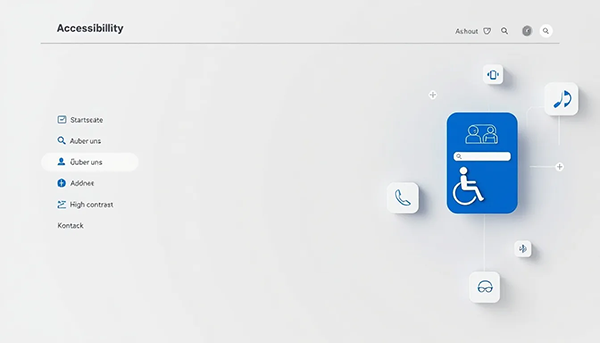
The requirements for accessible websites are defined by BITV 2.0 and WCAG 2.1. These guidelines require an accessible Design for IT applications to make them accessible to people with disabilities.
The WCAG 2.1 consists of four main principles:
- Perceptibility
- usability
- Comprehensibility
- robustness
These principles ensure that websites are accessible to all users, regardless of their abilities or limitations. The individual principles and their requirements are explained in more detail below.
Perceptibility
Perceivability requires that content is designed to be perceived by all users, including people with disabilities. Information should be provided in such a way that it can be perceived through multiple senses, for example through visual and auditory means.
Perceivability requires that content is designed to be perceivable by all users, including people with disabilities. Here are some key points to consider:
- Information should be provided in such a way that it can be perceived through different senses.
- Visual aids should be clear and understandable.
- Auditory means should be clear and easily audible.
The Accessibility Strengthening Act (BFSG) will make digital accessibility mandatory for everyone from 2025. An accessible website can benefit considerably from the implementation of assistive technologies such as screen readers.
By using assistive technologies and providing information in different formats, websites can ensure that all users, regardless of their abilities, have access to the content provided.
usability
Websites should be keyboard and mouse friendly, provide clear page titles and link text, and give users enough time to navigate. This is especially important for people with motor disabilities who may have difficulty using a mouse.
Creating accessible websites may require a large initial investment, but it offers long-term benefits and savings for businesses. A usable website improves the user experience and increases user satisfaction, which can lead to higher customer loyalty.
By implementing clear navigation structures and providing sufficient time for interactions, websites can ensure that all users, regardless of their abilities, can use the services offered.
Comprehensibility
Content should be presented in easy-to-understand language and clearly. The use of clear contrasts and simple language is crucial for the accessibility of a website.
Alternative text for images is necessary to make information accessible to users with visual impairments. This text provides a description of the image content and enables users who rely on screen readers to understand the information.
Training everyone involved in the process is an important measure for implementing accessibility in web design. Through regular training, web developers and other participants can learn how to present content clearly and comprehensibly.
robustness
Content delivery should comply with common web standards to ensure compatibility with different browsers and assistive technologies. Websites should be developed to be compatible with different browsers and assistive technologies.
A clear structure for screen readers is an important requirement for accessible websites. By complying with these requirements, websites can ensure that all users, regardless of the technology used, have access to the content provided.
Implementation of Accessibility in Practice
When implementing accessibility in practice, it is important to involve all stakeholders in the process. This includes web developers, designers, content creators and other stakeholders who must work together to create an accessible website.
By involving all stakeholders and using appropriate tools and testing, websites can be designed to meet accessibility requirements and provide a positive user experience.
tools and tests
The BITV test evaluates all the requirements set out in the BITV and ensures that these criteria are fully met. This test provides a comprehensive review of the accessibility of websites and identifies areas that need improvement.
The WAVE Accessibility Checker provides a check for WCAG requirements and recommended actions. This tool helps web developers identify and fix potential barriers before the website goes live.
The Color Contrast Checker is a useful tool for checking the color contrast on web pages. Ensuring that the color contrast meets requirements can help make websites more accessible for people with visual impairments.
Training and continuing education
Regular training encourages employee commitment to accessible web design. This training can help web developers and other stakeholders understand and implement accessibility principles.
It is recommended to offer training to web developers to raise awareness of accessibility. Through continuous education, companies can ensure that their employees are always up to date with the latest requirements and best practices.
Case Studies
For the websiterelaunch The CMS Statamic was chosen. This CMS offers flexible and powerful features that support the creation of an accessible website.
The following requirements were implemented in the accessible website: full keyboard usability, support for simple language, optimal contrast and a clear structure for screen readers. The implemented requirements significantly improve the user experience, especially for people with disabilities, and promote the accessibility of all content.
Costs and Benefits of Accessible Websites
Accessible websites improve usability and increase reach, resulting in a larger user base and potentially higher revenue for businesses.
Implementing accessible websites may require significant initial investment, but offers long-term benefits and savings for businesses.
investment costs
For a comprehensive Analysis of a website, which is tested for accessibility, the costs can range from 600 to 1.200 euros. These costs vary depending on the complexity of the website. A simple website incurs lower costs, while complex websites such as online shops can require budgets of up to 10.000 euros to carry out comprehensive tests and reports.
Additional costs may apply. These arise from:
- translations of texts
- the production of sign language videos
- the creation of accessible PDFs
- multimedia offerings
However, these investments are necessary to ensure that the website meets accessibility requirements and is accessible to all users.
Economical advantages
Investments in accessible websites can be economically worthwhile through a broader user base. Accessible websites can expand the user base and thus potentially lead to higher sales. In addition, they increase customer satisfaction, which can lead to increased customer loyalty and sales.
search engines Websites reward accessible web design. This leads to better backlinks in their search results. This means that accessible websites not only have a wider reach but are also more visible in search results.
The goal of implementing barrier-free web design is therefore maximum user-friendliness and sustainable economic development for companies.
deadlines and schedules
All websites in the EU must be accessible to people with disabilities by June 28, 2025 at the latest. From mid-2025, legal requirements for the accessibility of websites and apps will come into force, based on the Accessibility Strengthening Act (BFSG). These deadlines are crucial to ensure that all new content on websites meets accessibility requirements.
Existing content must be adapted to meet legal requirements by mid-2030. Companies should adhere to these timelines to avoid potential penalties and sanctions.
deadline June 28, 2025
The Accessibility Strengthening Act (BFSG) comes into force on June 28, 2025. This date marks the beginning of the obligation to ensure accessibility for companies in the B2C sector. From this date, all new content on websites must be accessible. Accessibility is crucial here. Companies with more than 10 employees or a balance sheet total of more than 2 million euros are obliged to implement accessibility.
If a company does not comply with accessibility requirements, it will be informed and given a deadline to revise; non-compliance will result in a penalty. Existing content must be adapted by mid-2030 to meet legal requirements.
adjustment periods
There is a mid-2030 deadline for adapting existing content. Companies should ensure they meet this deadline to meet accessibility requirements and avoid potential sanctions.
Adapting existing content in a timely manner is crucial to ensure that all users, including people with disabilities, have access to the content provided. Companies should therefore start implementing early to meet the requirements in a timely manner.
control and enforcement
Market surveillance authorities are responsible for checking compliance with legal accessibility requirements. These authorities carry out random checks to ensure that websites comply with legal requirements.
Failure to comply with accessibility requirements can result in significant fines for companies, which can amount to tens of thousands of euros depending on the region. Companies should therefore ensure that their websites comply with the requirements to avoid sanctions.
market surveillance
Market surveillance authorities are empowered to identify digital barriers and assess accessibility compliance. These authorities can not only act on their own initiative but can also be called upon to act by complaints from consumers or associations.
Through regular checks and audits, market surveillance authorities ensure that websites comply with legal requirements and that all users have access to the content provided.
Sanctions
If companies fail to comply with accessibility regulations, they can be fined several thousand euros. These sanctions are intended to ensure that companies take the legal requirements seriously and implement them.
Companies that do not implement accessibility requirements could be excluded from public tenders. In serious cases, their online business could even be temporarily shut down if they repeatedly fail to respond.
Summary: Key takeaways about intuitive eating
Website accessibility is not only a legal obligation, but also an ethical and economic necessity. By complying with legal requirements and implementing accessible web design principles, companies can ensure that their digital offerings are accessible to all users.
It is important to start implementing accessibility early and use appropriate tools and training to meet the requirements. Let's create an inclusive digital world together, where no one is excluded due to disabilities.
Frequently Asked Questions
What is the Accessibility Strengthening Act (BFSG)?
The Accessibility Strengthening Act (BFSG) requires companies to make their websites barrier-free by June 28, 2025 in order to ensure the accessibility of digital offerings for all users.
What are the costs involved in implementing accessible websites?
The costs of implementing accessible websites can vary greatly depending on the complexity. While simple websites can cost between 600 and 1.200 euros, complex sites such as online shops can require up to 10.000 euros.
What economic benefits do accessible websites offer?
Accessible websites expand the user base and increase customer satisfaction, which can ultimately lead to better search engine rankings and higher sales.
What happens if a company does not comply with accessibility requirements?
Companies that do not comply with accessibility requirements may be subject to fines and may lose their eligibility for public tenders, as well as having their online business temporarily shut down.
What tools can be used to check accessibility?
To check the accessibility of websites, tools such as the BITV test, the WAVE Accessibility Checker and the Color Contrast Checker are recommended. These tools help to identify potential barriers and improve accessibility.