





9 Minutes reading time
Google was founded in September 1998. Over two decades have passed since then and the company has developed into the world's leading search engine. But how old is Google really? In this article we take a detailed look at the origins and key milestones of this impressive success story.
Key facts at a glance
- Google was founded in 1998 by Larry Page and Sergey Brin founded after starting the research project BackRub in 1996.
- Google's success was largely driven by early investments, the innovative PageRank process, and strategic acquisitions such as YouTube and Android.
- Despite its success, Google faces challenges such as privacy concerns and is relying on artificial intelligence to further improve future products and services.
The Beginnings of Google
Every great success story has its humble beginnings, and Google's begins with two brilliant minds: Larry Page and Sergey Brin. These two Stanford University PhD students had a vision that would change the Internet forever. Their journey began in 1996 with a research project called BackRubThis early version of a search engine laid the foundation for what would later become known as Google.
The founding of Google Inc. in September 1998 ushered in a new era of Internet research. The search engine quickly established itself as a leader in its field and changed the way people find and use information on the World Wide Web.
Founding in the Garage
Like many great companies, Google started in a garage. This garage in Menlo Park, California, became Google's first office after Larry Page and Sergey Brin received a crucial investment from Andreas von Bechtolsheim. This initial investment allowed the young company to leave the dorms and take its first steps toward the business world.
The work in the garage was characterized by hard work and innovative ideas. The founders worked tirelessly to improve and optimize their search engine. With limited resources and a few hard drives, they created a search engine that delivered precise and fast results, laying the foundation for Google's later success.
The role of BackRub
BackRub, the first version of the search engine, was a crucial step in Google's history, but nothing could better reflect the search engine's new vision and potential than the name Google itself.
This change marked the beginning of a new era in the world of search engines.
The way to success
The road to Google's success was paved with strategic decisions and innovative technologies. The renaming of BackRub to Google in 1997 was the first step towards a new search engine technologyThis decision ushered in a new chapter marked by early investments and the development of revolutionary search technologies.
One of the most important investments came from Andreas von Bechtolsheim, one of the co-founders of Sun Microsystems, who invested $1998 in the young company in 100.000. This investment was crucial in enabling Google to further develop its business ideas and establish itself as a leading search engine.
First investments
Andreas von Bechtolsheim's first investment was a turning point for Google. This capital enabled the company to expand its infrastructure and further develop its search technology.
This initial investment was the starting point for many other projects and innovations that made Google what it is today and the first project in a series of successes.
PageRank method
Another key factor in Google's success was the PageRank method developed by Larry Page. This groundbreaking method evaluated websites based on the number and quality of incoming Links, which provided more precise and relevant search results. The idea behind it was that hyperlinks act as recommendations between web pages and thus determine their popularity and relevance.
The Page Rank This process revolutionized the search engine world by introducing an algorithmic approach to determining the relevance of web pages. Thanks to this innovative evaluation method, Google was able to quickly gain popularity and establish itself as the leading search engine.
Milestones in Google's history
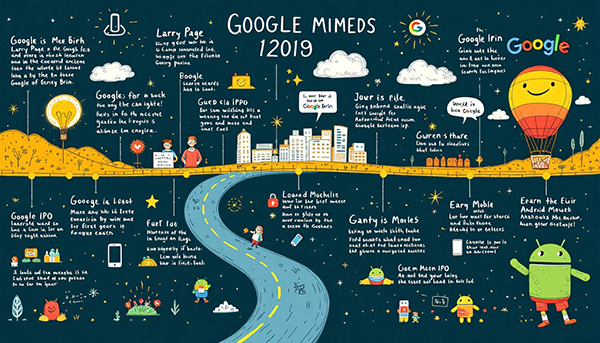
Over the years, Google has achieved numerous milestones that have cemented its position as the leading search engine. Today, Google has a global market share of over 90 percent, which underlines its dominance in the search engine landscape. In Germany, too, Google is the undisputed market leader with a market share of 95 percent.
These milestones are the result of continuous expansion and strategic decisions that have made Google a global technology company. From opening its first office in Palo Alto to introducing new technologies and services, Google has always strived to organize the world's information and make it universally accessible.
expansion and growth
Google's expansion began early, when the company opened its first office in Palo Alto, California, in February 1999. This expansion was an important step in realizing the founders' vision of organizing the world's information and making it universally accessible and usable.
The name Google was introduced on September 15, 1997, and symbolized the goal of capturing and making an unlimited amount of information accessible. This vision and continuous growth have made Google one of the largest and most influential technology companies in the world.
initial public offering
Google's IPO on August 19, 2004 was another important milestone. The stock was offered at a price of $85, allowing the company to raise over $1,67 billion in capital. This IPO was one of the largest in the tech industry up to that point and led to a significant increase in share prices.
Important acquisitions
Over the years, Google has made several strategic acquisitions that have significantly strengthened its market position. One of the most significant acquisitions was that of YouTube in 2006 for $1,65 billion in stock. This acquisition allowed Google to consolidate its position in the online video segment and to develop new sources of revenue.
Another example is the acquisition of Android in 2005, which enabled Google to enter the smartphone market. This and other acquisitions have helped Google expand its market position and diversify its services and products.
Google today
Today, Google is much more than just a search engine. The company offers a variety of services and products that affect people's daily lives in many ways. Google Maps, Google Scholar to Gmail and Google Drive Google has developed a wide range of tools that are used worldwide.
AdWords, launched in 2000, laid the foundation for Google's advertising business today and made the company one of the largest advertising platforms in the world. These and other innovations have made Google an indispensable part of modern life.
Services and products
Google offers a variety of services ranging from email services like Gmail to cloud solutions like Google Cloud. These services are designed to make users' lives easier and provide businesses with innovative solutions for their data processing and storage needs.
Google Maps recently introduced the Immersive View for Routes feature, which allows users to plan their trips in a realistic representation. Google also uses artificial intelligence to improve its products such as the Magic Editor" in Google to constantly improve photos.
Criticism and challenges
Despite its success, Google also faces challenges and criticism. One frequently voiced criticism is the way Google handles and processes user data. Data protection concerns and the transparency of Google services are always the subject of discussion.
An example of this is google analytics 4, which has come under criticism for data protection deficiencies, particularly with regard to data transfer to the USA. These challenges show that, despite its success, Google must constantly work to gain and maintain the trust of its users.
Future prospects
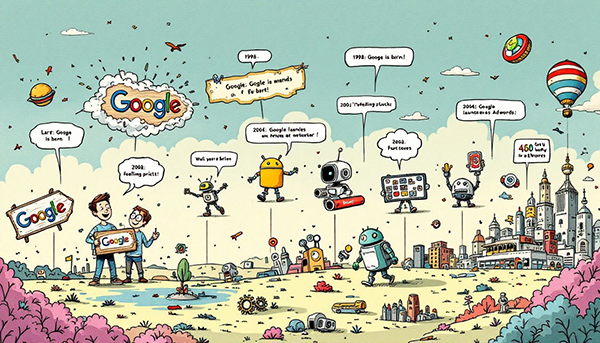
Looking ahead to Google's future, the company continues to focus on innovation and technological developments, with a particular focus on integrating artificial intelligence into Google's core products to make them even more useful.
Google plans to integrate generative AI into various applications such as Google Workspace to increase efficiency and usability. These and other innovations show that Google is committed to maintaining and further expanding its leadership position in the technology industry.
Artificial Intelligence
The development and integration of artificial intelligence is a central part of Google's future strategy. The new language model PaLM 2 is faster and more efficient than its predecessors and is used in over 25 products. These advances in AI technology help Google to continuously improve its products and services.
Med-PaLM 2 is a special variant of the language model that has been trained for medical knowledge and helps answer complex medical questions. These and other developments show how Google is using artificial intelligence to advance humanity and provide users with better information.
Innovations and developments
Google is constantly working on new technologies and innovations to improve the user experience. One example of this is the seamless integration of online and offline customer experiences, which enables users to make their interactions with Google products even more seamless.
This culture of innovation is an essential part of Google's success and will continue to play a central role in the future.
Summary: Key takeaways about intuitive eating
The history of Google is a fascinating example of innovation and entrepreneurship. From humble beginnings in a garage to becoming one of the most powerful technology companies in the world, Google has revolutionized the way we use the Internet. Its key milestones, challenges and future prospects show that Google is constantly striving to evolve and improve. Let's look forward to what this impressive company will do in the future.
Frequently Asked Questions
When was Google founded?
Google was founded in September 1998 by Larry Page and Sergey Brin.
Where was Google originally developed?
Google was originally developed in a garage in Menlo Park, California.
What was the original name of Google?
The original name of Google was BackRub before it was changed to Google.
What is the PageRank method?
The PageRank method evaluates websites by analyzing the number and quality of incoming links. It is used to determine the relevance and authority of pages on the Internet.
What major acquisition did Google make in 2006?
Google acquired YouTube in 2006 for $1,65 billion in stock. This was a significant expansion into the online video platform space.