






11 Minutes reading time
Augmented reality (AR) Augmented Reality augments our real world with digital content. But how does this technology work and where is it used? In this article, you'll learn the basics of augmented reality, its functionality, and its applications. Learn how AR is revolutionizing our everyday lives.
Key facts at a glance
- Augmented Reality (AR) enhances physical reality by integrating digital content, improving interactivity and user experience.
- The technology has diverse applications in education, industry and entertainment, providing more efficient processes and more engaging learning experiences.
- Despite implementation challenges and mature technologies, AR remains a promising field with potential for innovation and growth.
Augmented Reality Definition
Augmented reality, often abbreviated to AR, is a form of enhanced reality that augments the real world with virtual elements. The goal of an augmented reality app is to enhance physical reality with digital information, creating an interactive experience that seamlessly connects the digital and real worlds. This augmented reality AR technology allows us to see and interact with contextual additions in our environment to experience different realities.
Unlike virtual reality, where the user is fully immersed in a digital world, AR augments the real world rather than replacing it. This means that users continue to perceive their physical environment while simultaneously enriching it with digital information. One example is AR headsets that overlay digital content over real-world objects, thus enabling augmented perception.
The applications of augmented reality are diverse and range from:
- Education
- Industry
- Conversation
- Marketing
- Application
AR apps on smartphones and tablets are widespread and offer an easy way to take advantage of this app technology. By integrating AR into our everyday lives, we can create new, interactive experiences that enhance our understanding and interaction with the world around us.
History of Augmented Reality
The history of augmented reality dates back to the 1980s, when Tom Furness developed the 'Super Cockpit' for pilots. This system displayed additional information through a transparent screen, laying the foundation for the development of AR technologies.
Another milestone was the development of the first open source software toolkit for augmented reality in 1999 by Hirokazu Kato. The AR toolkit enabled developers to create AR applications and contributed significantly to the widespread adoption of the technology.
In 2012, Google launched the Google Glass, which brought augmented reality to wider public attention, even though the product itself was not a commercial success. A significant breakthrough was the introduction of Microsoft HoloLens in 2016, which enabled users to view and interact with digital content in the real world.
How augmented reality works

Augmented reality works through the interplay of hardware, software, and a user interface that work together to display digital information in the real world. The physical components required to enable AR include displays, computers, and sensors. These components work together to ensure seamless integration of digital content into the physical environment.
AR glasses often use depth perception, achieved with the help of two separate cameras or a depth sensor. This allows virtual elements to be precisely anchored in reality, regardless of the user's position. One of the easiest ways to interact with AR is via a smartphone's touchscreen, which allows for the manipulation of digital content in real time. Using a AR glasses can further enhance this interaction and is an important part of the user experience. Furthermore, the camera in AR glasses is often used to capture the environment, while the device's screens support the display of content.
In advanced applications, information is created through real-time scanning of the environment and the placement of digital 3D objects, primarily this digital information, either manually provided by users or automatically generated by peripherals. Advances in AR hardware have led to more convenient form factors, longer battery life, and higher performance, further enhancing the user experience and the benefits of augmentation. The object plays a central role, with orientation playing an important role and the device playing a crucial role.
Difference between Augmented Reality and Virtual Reality
Augmented Reality and Virtual Reality (VR) are two related yet distinct technologies. While AR uses software and hardware to overlay digital content over real-world objects, augmenting the real world, VR completely replaces the real world, creating a fully immersive virtual reality environment.
In augmented reality, users can interact with the real environment, while virtual reality offers complete isolation from the real world. These differences make both technologies attractive and useful for different applications and user experiences.
Advantages of Augmented Reality
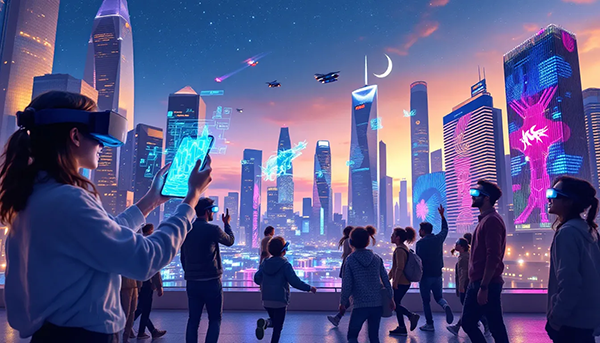
Augmented reality offers numerous benefits in various fields. In education, AR enhances learning through interactive 3D models and simulations, making it easier to understand complex topics. This leads to increased learner motivation and makes teaching more engaging and effective.
In industry, AR increases efficiency by displaying specific information directly in an employee's field of vision, thus increasing safety. This facilitates equipment maintenance and repair and improves productivity.
In the entertainment sector, AR enhances the user experience through immersive gameplay elements that connect the real and digital worlds. Successful examples like Pokémon Go demonstrate AR's potential to revolutionize the entertainment industry and create new, interactive experiences.
Augmented Reality Applications
Augmented reality shows promising applications in various fields such as marketing, education, and industry. Companies use AR to interactively display products and enhance the user experience. One important application of augmented reality is improving customer interaction. Furthermore, augmented reality apps are gaining increasing importance.
In the following sections, we'll delve into specific applications of AR in education, industry, and entertainment. Each of these categories demonstrates how versatile and useful augmented reality can be in our everyday lives.
Education
In education, augmented reality has the potential to transform learning. By integrating AR into the classroom, complex Concepts can be made more vivid and understandable. For example, flat images in textbooks can be replaced with interactive 3D models, making learning more engaging. An image can help make the content even more tangible.
AR applications can provide personalized learning content tailored to students' individual needs. This leads to increased learner motivation and promotes a deeper understanding of the learning content. AR applications play a crucial role in this.
A practical example of the use of AR in education is the representation of dinosaurs as interactive virtual models that help students better understand these prehistoric creatures. Such applications can be used both in physical classrooms and in immersive distance learning courses to create a better representation of reality. Examples of such applications are diverse.
Industry
In industry, augmented reality is used for a variety of applications, including asset identification, training, design, and maintenance. For example, technicians can be assisted by digital guides during equipment maintenance and repair, increasing efficiency and reducing errors.
AR enables employees to view three-dimensional information about machines in real time, improving the planning and execution of maintenance work. Integrating AR with digital twins and the AR system facilitates the planning and execution of maintenance work and promotes teamwork, as multiple users can interact with the digital content simultaneously.
In quality control, AR helps detect defects and improve product quality through object recognition and machine learning. These applications demonstrate how AR can revolutionize industry by optimizing processes and increasing productivity.
Conversation
The entertainment industry has quickly embraced and successfully integrated augmented reality. AR games like Pokémon Go have proven that the technology has the potential to revolutionize the way we play. These games allow users to experience and interact with virtual elements in the real world, making the gaming experience more exciting and immersive.
AR has established itself as a significant technology in the entertainment industry, offering numerous opportunities for innovative and interactive videos. By combining virtual and real worlds, new and exciting forms of entertainment can be created that push the boundaries of what's possible.
The future of augmented reality in entertainment is promising. As technology advances, new applications and games are being developed that are even more immersive and interactive. These developments demonstrate the enormous potential of AR to transform the entertainment industry.
Augmented Reality Technology

The technology behind augmented reality is complex and fascinating. One of the key technologies is SLAM (Simultaneous Localization and Mapping). This technique enables AR devices to map the environment in real time and precisely position digital objects. It is frequently used by advanced AR devices to ensure seamless integration of digital content.
Advanced AR headsets like the Apple Vision Pro offer immersive experiences by seamlessly integrating digital content into the real world. These augmented reality headsets are equipped with modern sensors and cameras that enable precise capture and representation of the environment.
3D registration is another important aspect of AR technology, as it ensures that virtual objects are represented stably and realistically within the physical environment. This precise placement is crucial to the user experience and makes AR a powerful technology for a wide range of applications.
Challenges and future of augmented reality

Despite its enormous potential, augmented reality still faces several challenges. The technology is often not yet fully developed, making companies hesitant to use it for complex projects. However, pilot projects in specific areas help test the effectiveness of AR before its larger-scale implementation.
The future of augmented reality looks promising. There are many opportunities for growth and innovation in this field. Technological advances and declining costs are making AR more accessible to many businesses. Over time, AR is expected to play an even larger role in various industries, creating new opportunities for innovation and efficiency.
Implementation of augmented reality in the company
Successful implementation of augmented reality in enterprises begins with a fundamental understanding of the technology and identifying relevant use cases. Leveraging proven AR solutions is advisable to minimize risk and accelerate implementation.
Scalable AR applications are important to ensure their long-term use and value for the business. Modern smartphones are capable of creating AR content by generating 3D models and precise maps of real-world objects. However, a significant barrier to AR adoption is the initial investment, which is often too high for smaller companies.
To fully utilize the benefits of augmented reality, extensive employee training is required. This training ensures that the technology is used effectively and that employees acquire the necessary skills to successfully deploy AR applications.
Summary: Key takeaways about intuitive eating
Augmented reality has the potential to enrich and transform our everyday lives in a variety of ways. From education to industry to entertainment, AR offers numerous opportunities to improve learning, efficiency, and the user experience. The technology behind AR is impressive, and despite some challenges, the future holds promise.
Successfully implementing AR in enterprises requires a deep understanding of the technology, proven solutions, and comprehensive employee training. These measures enable companies to fully leverage the benefits of AR and create innovative, interactive experiences.
We hope this blog post has given you a comprehensive insight into the world of augmented reality and inspired you to further explore the possibilities of this fascinating technology.
Frequently Asked Questions
What is augmented reality?
Augmented Reality (AR) is a technology that integrates digital information into the real world, making virtual elements visible. This innovative technique augments the physical environment and significantly improves the user experience.
How does augmented reality differ from virtual reality?
Augmented reality enhances the real world with digital content, while virtual reality completely replaces the real world and creates an immersive digital environment. This distinction is crucial for understanding the potential applications of both technologies.
What are the benefits of augmented reality in education?
Augmented reality in education offers the benefits of interactive 3D models and simulations that improve understanding of complex topics and increase learner motivation.
How does augmented reality work in industry?
Augmented reality (AR) in industry works by providing digital guidance and real-time information that aids asset identification, training, design, and maintenance. This increases efficiency and significantly reduces errors.
What are the challenges in implementing augmented reality?
Implementing augmented reality faces challenges such as the lack of technology maturity and high initial investment costs. Furthermore, comprehensive employee training is required to fully utilize the benefits of AR technology.